Photo : Onceinawhile — CC BY-SA 4.0, Wikimedia Commons
Cairo · Fustat
National Museum of Egyptian Civilisation
The royal mummies have been here since 2021, and the story runs right up to Egypt today.
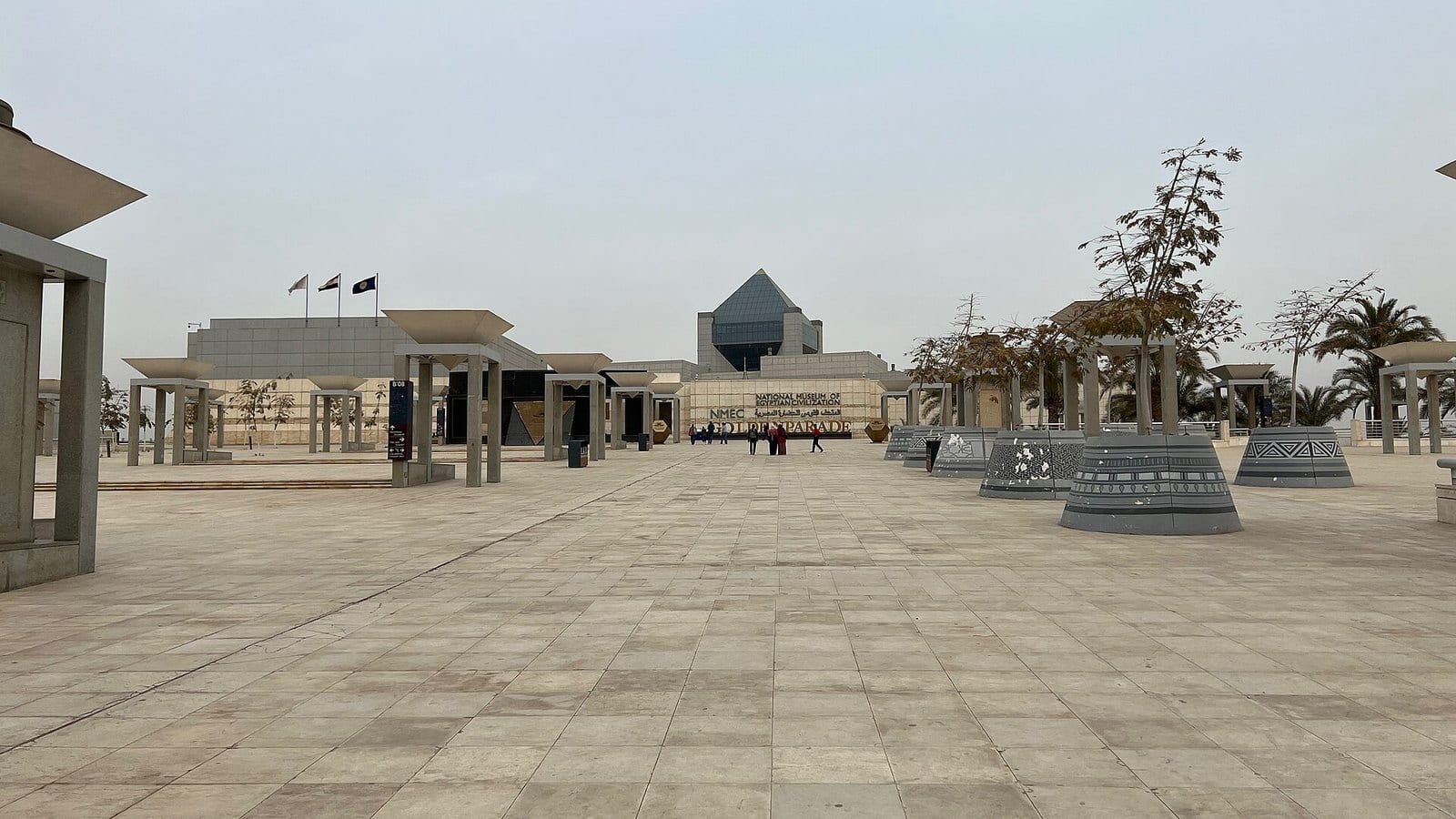
The museum occupies a large concrete building on the edge of Ain el-Sira lake in Fustat, the first city the Muslims founded in Egypt; the forecourt is paved and bare, and the roof falls away in a slope like a dark pyramid. It was conceived not as a museum of antiquities but as a museum of civilisation: the central gallery runs through time from prehistory to contemporary Egypt, and thematic halls then take over — the Nile, writing, state and society, the crafts, belief. The royal mummies brought down from the Tahrir museum in 2021 have a hall of their own below, kept dim and quiet, each coffin and each face lit on its own. Its remit does not stop at the pharaonic: Coptic, Islamic, textiles, instruments, down to objects from the last century.
The extra bit
Keep the mummies hall for the end rather than the start: it is the one room you do not come out of ready to look at display cases. And if you have come from Tahrir Square, the Tutankhamun treasure is no longer there and is not here either: it is at the Grand Egyptian Museum in Giza.
Know before you go
The royal mummies hall is visited in the dark, and you will be asked to put cameras away: ask at the ticket desk whether it is included in the ticket and whether photography is allowed. The building is large, the museum opened in stages and not every hall is open at once, so don't build a whole day around it. This is the quarter of Coptic Cairo and Souq El-Fustat, worth doing in one outing, but the museum sits apart and you will not reach it on foot from the corniche.